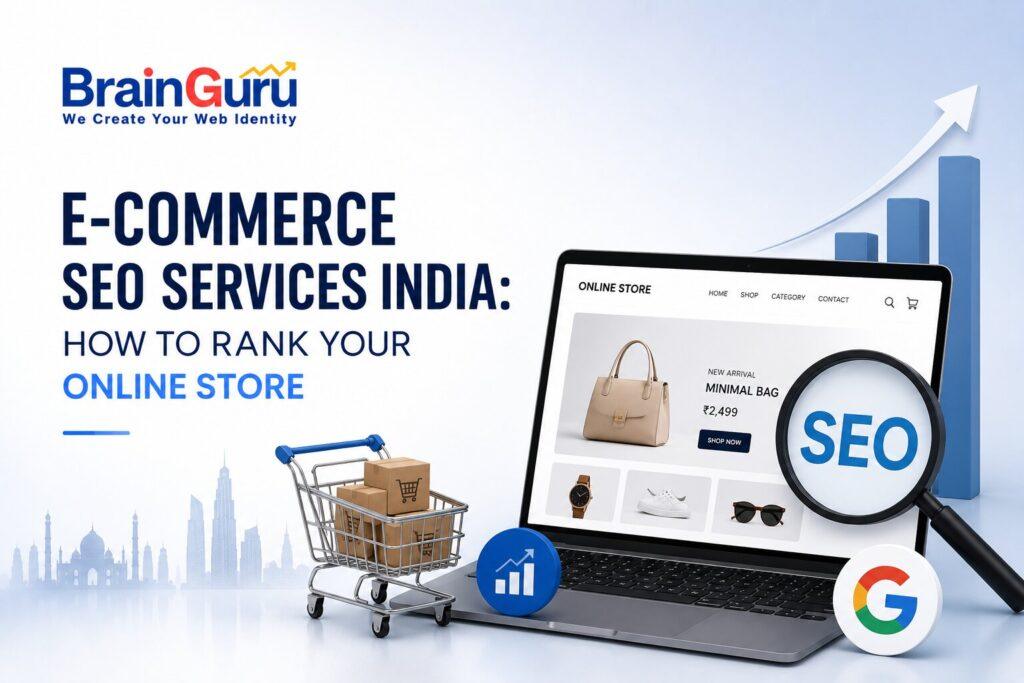
The Indian e-commerce landscape has matured into one of the most competitive digital markets in the world. Between Flipkart, Amazon, Meesho, Myntra, Nykaa, and a rapidly expanding D2C layer of direct-to-consumer brands, the online shelf is crowded and shopper attention is scarce. In that environment, ecommerce SEO services India are no longer a nice-to-have marketing line item. They are the single most durable competitive moat an online store can build in 2026.
This guide is written for e-commerce founders, category heads, and digital leads who are tired of burning margin on paid acquisition and want a clear-eyed view of what modern e-commerce SEO looks like, what it costs, and what results to expect. We will cover platform-specific considerations, schema, pricing, mistakes to avoid, and measurement, with a focus on the Indian market.
Why E-commerce SEO is Critical for Indian Online Stores in 2026
India’s e-commerce market is projected to cross USD 150 billion by the end of 2026, driven by Tier-2 and Tier-3 city consumers, UPI-led checkout frictionlessness, and vernacular search adoption. According to aggregate industry data from IBEF, Bain, and Redseer, more than 80 percent of online shoppers begin their product discovery on Google before they click a paid ad, visit a marketplace, or open a brand website directly.
That discovery gap is where organic SEO earns its keep. The average blended customer acquisition cost on Meta Ads for Indian D2C brands has increased by roughly 40 to 60 percent over the last three years, while Google Shopping CPCs in competitive verticals like apparel, beauty, electronics, and nutrition have doubled. Meanwhile, organic traffic, once acquired, compounds. A product page that ranks in position one to three for a commercial intent keyword can deliver qualified buyers for 18 to 36 months with only incremental maintenance.
The ROI math is straightforward. If your paid ad blended ROAS is 2.5x and your organic ROAS is effectively 8x to 15x once content is ranking, every rupee moved from paid to organic over a 24-month horizon delivers multiples of EBITDA uplift. That is why serious Indian e-commerce operators now treat SEO as a core P&L function, not a vendor-driven afterthought.
How E-commerce SEO Differs from Regular SEO
E-commerce SEO is a distinct discipline. The patterns that work for a SaaS blog or a local service business break down at the scale and structure of an online store. Here is what makes e-commerce SEO fundamentally different.
Product pages at scale. A mid-sized Indian online store has anywhere from 500 to 50,000 SKUs. Each SKU needs a unique title tag, meta description, on-page copy, image alt text, and schema. Manual optimization is impossible at that scale. You need templated systems, rules engines, and periodic human QA.
Faceted navigation issues. Filters like color, size, price range, and brand create a combinatorial explosion of URLs. Without careful canonicalization, robots.txt rules, and parameter handling, Google will crawl hundreds of thousands of near-duplicate URLs, diluting your crawl budget and confusing relevance signals. This is the single most common technical SEO failure on Indian e-commerce sites.
Inventory turnover impact. Products go out of stock, get discontinued, or move to different category trees. Each of those events has SEO implications. An out-of-stock product still ranking for a valuable query should not return a 404. It should either redirect to a replacement product, show “notify me” messaging with fresh content, or surface similar SKUs to preserve user intent.
Schema markup specifics. E-commerce has the richest schema ecosystem of any vertical. Product schema, Offer schema, AggregateRating, Review, BreadcrumbList, and Organization markup interact to produce rich results in Google Search, Google Shopping, and increasingly AI-powered search overviews. Miss any one and you lose visible real estate in the SERP.
Transactional intent mapping. Unlike content SEO, where informational queries dominate, e-commerce SEO must map the full funnel: informational (buying guides), navigational (brand + model), commercial (best X for Y), and transactional (buy X online India). Each intent needs a different page type.
Core Components of E-commerce SEO Services
A credible e-commerce SEO engagement in India covers the following pillars. Anything less is partial work and will cap your ranking ceiling.
Technical SEO
Technical SEO is the foundation. Core Web Vitals scoring, particularly Largest Contentful Paint on product pages, directly influences both rankings and conversion. Indian mobile users on 4G connections are unforgiving; if your product page takes more than 2.5 seconds to render the primary image, you lose the sale and the ranking. Technical work includes site architecture, internal linking depth, XML sitemap segmentation (products vs categories vs blog), robots.txt tuning, canonical tag discipline, hreflang for multi-country stores, structured data implementation, and crawl budget optimization.
Product Page Optimization
Product pages convert, but only if they rank. Optimization covers title tags (formula: Product Name + Key Attribute + Brand + Year, under 60 characters), meta descriptions with CTR hooks, unique descriptions at least 150 to 300 words, image alt text with descriptive keywords, video schema where applicable, FAQ sections answering buyer questions, and trust signals like reviews, return policies, and delivery timeframes.
Category Page SEO
This is where most Indian stores leave the largest amount of money on the table. Category pages typically rank for the highest-volume, highest-converting head terms like “running shoes for men” or “wireless earbuds under 3000.” They aggregate buyer intent across the whole catalog. A well-optimized category page has a 300 to 600 word introduction above or below the product grid, internal links to subcategories and buying guides, schema markup, and clean filter handling.
Local SEO
For stores with physical retail, local SEO is a separate discipline. Google Business Profile optimization, local landing pages per city or store, NAP consistency across 50+ Indian directories, local schema, and review acquisition strategies all drive store visits and “near me” mobile conversions.
Content Marketing
Buying guides, comparison posts, and gift lists are the top-of-funnel workhorses. An Indian beauty brand that publishes “Best Sunscreens for Oily Skin in Indian Summers” captures search demand six months before the buyer is ready to transact. Content also attracts backlinks, which compound domain authority.
Link Building
Digital PR, partnerships with niche Indian publications, product review outreach to category influencers, and unlinked brand mention conversion are the four credible link tactics in 2026. Anything involving bulk guest posts or PBNs is no longer defensible and will eventually draw manual action.
Platform-Specific SEO: Shopify vs WooCommerce vs Magento
Platform choice materially affects what SEO work is possible, how much it costs, and how fast you can execute. The table below summarizes the trade-offs.
| Dimension | Shopify | WooCommerce | Magento (Adobe Commerce) |
|---|---|---|---|
| Out-of-box SEO | Solid basics, clean URLs, auto-generated sitemaps | Requires Yoast or Rank Math plus configuration | Powerful but complex; needs expert setup |
| Customization depth | Limited by Liquid templates and app availability | Full PHP/WordPress freedom | Enterprise-grade, deeply customizable |
| Core Web Vitals | Good with Dawn/Sense themes, can degrade with apps | Depends heavily on hosting and theme | Requires dedicated performance tuning |
| Schema support | Basic product schema native, enhanced via apps like JSON-LD for SEO | Full control via plugins | Native and extensible |
| URL structure | /products/ and /collections/ fixed | Fully customizable | Fully customizable |
| Faceted navigation | Limited, needs apps like Smart Product Filter | Full control with plugins | Native layered navigation |
| Multi-store support | Shopify Markets for basic, Plus for advanced | Multisite plugin workarounds | Native multi-store |
| Ideal catalog size | Up to 10,000 SKUs comfortably | Up to 5,000 SKUs comfortably | 10,000 to 1M+ SKUs |
| Monthly platform cost (INR) | Rs 2,400 to Rs 1.8L+ | Rs 500 to Rs 15,000 (hosting dependent) | Rs 50,000 to Rs 5L+ |
| SEO ceiling | Medium-high | High | Very high |
For most Indian D2C brands in the Rs 1 crore to Rs 50 crore GMV range, Shopify hits the right balance of speed-to-market and SEO capability. Above Rs 100 crore GMV with complex catalog needs, Magento or a headless stack on BigCommerce or Commerce Layer becomes worth the investment.
Schema Markup Every Indian E-commerce Site Needs
Schema is how you speak Google’s language. In 2026, with AI Overviews and Search Generative Experience pulling structured data directly into answer boxes, schema is no longer optional. Below are the six schemas every Indian e-commerce site should implement.
Product schema carries name, image, description, brand, SKU, GTIN, and most importantly, nested Offer schema with price, priceCurrency (INR), availability, priceValidUntil, and shipping details.
Offer schema tells Google the commercial terms. Getting this right unlocks the price chip, the availability indicator, and shipping transparency in SERPs.
AggregateRating and Review schema power the star rating display that can lift organic CTR by 30 to 50 percent. Reviews must come from verified purchasers, and the schema must match on-page visible content, or you risk a structured data manual action.
BreadcrumbList schema replaces the URL string in the SERP with a clean breadcrumb, improves perceived brand trust, and helps Google understand site hierarchy.
Organization schema on the homepage carries logo, social profiles, contact points, and customer service information. This is the foundation of brand entity signals that now feed AI search answers.
FAQPage schema on product and category pages, used judiciously and in compliance with Google’s current guidelines, can still deliver rich result visibility for long-tail queries.
Implementation can be done via Shopify apps like JSON-LD for SEO, WooCommerce plugins like Rank Math Pro, or for headless stacks, direct JSON-LD injection in the template layer.
E-commerce SEO Pricing in India (2026)
Indian e-commerce SEO pricing has stratified sharply by catalog size, competitive intensity, and scope of work. The ranges below reflect current market rates for credible agencies with a verifiable track record.
| Store Size | SKU Count | Monthly Retainer (INR) | Typical Scope |
|---|---|---|---|
| Small store | 1 to 100 products | Rs 25,000 to Rs 50,000 | Technical audit, 20 to 40 product pages optimized, 2 blogs/month, basic link building |
| Medium store | 100 to 1,000 products | Rs 50,000 to Rs 1,50,000 | Full technical SEO, 100+ product pages templated, category SEO, 4 to 8 blogs/month, digital PR |
| Large store | 1,000 to 10,000 products | Rs 1,50,000 to Rs 5,00,000 | Enterprise technical SEO, automated product page optimization, programmatic category expansion, PR, conversion rate work |
| Enterprise | 10,000+ products | Rs 5,00,000+ | Dedicated squad, custom tooling, international SEO, editorial team, link equity management |
One-time project engagements such as a comprehensive technical audit typically range from Rs 75,000 to Rs 3,00,000 depending on depth. Migration SEO, such as a Magento to Shopify replatform, is priced between Rs 1,50,000 and Rs 7,50,000 given the risk of traffic loss during a poorly managed migration.
Avoid retainers under Rs 20,000 per month. At that price point, no credible agency can deliver technical depth, content, and link building simultaneously. What you typically receive is a monthly report with vanity metrics and no real ranking movement.
Common E-commerce SEO Mistakes Indian Stores Make
Seven mistakes recur across almost every Indian e-commerce audit we conduct. Each one has a direct revenue cost.
Duplicate product descriptions copied from manufacturer feeds. Fix: rewrite at least the top 20 percent of SKUs by revenue with unique, benefit-led copy. Use AI tools for drafts but mandate human editing.
Missing or broken schema markup. Fix: audit via Google Rich Results Test, deploy a platform-appropriate schema solution, and monitor Search Console’s Enhancements report weekly.
Poor mobile UX and Core Web Vitals. Fix: compress images to WebP/AVIF, defer non-critical JavaScript, preload LCP images, and audit third-party scripts that fire on product pages.
Faceted navigation creating crawl traps. Fix: use robots.txt to block non-indexable parameters, add canonical tags pointing to the clean category URL, and use parameter handling in Google Search Console.
No internal linking strategy. Fix: link from blog content to relevant category and product pages, build hub-and-spoke structures, and ensure no orphan products exist more than three clicks from the homepage.
Ignoring out-of-stock product SEO. Fix: keep high-traffic OOS pages live with notify-me forms, similar product suggestions, and structured data indicating limited availability rather than 404-ing them.
Thin category pages with no unique content. Fix: add 300-plus words of category-level context, buying advice, and internal links above or below the product grid.
How to Measure E-commerce SEO Success
Measurement is where most SEO engagements fail to prove value. Vanity metrics like “keywords ranked” mean little without revenue attribution. The Indian e-commerce measurement stack we recommend is the following.
GA4 with enhanced e-commerce tracking configured to capture view_item, add_to_cart, begin_checkout, and purchase events with full product-level detail. Organic traffic should be segmented as a primary dimension against transactions, conversion rate, and average order value.
Google Search Console with property verification at the domain level, weekly tracking of impressions, clicks, and average position for the top 200 commercial queries, and monthly review of Enhancements and Core Web Vitals reports.
Revenue attribution using last non-direct click as the baseline model and data-driven attribution for directional guidance. Track assisted conversions where organic plays a role earlier in the path but paid closes.
Rank tracking for the top 100 to 500 keywords, segmented by intent and landing page type, using tools like Ahrefs, Semrush, or Indian-market alternatives like SE Ranking.
Profitability analysis. Plot SEO spend against organic revenue contribution over a rolling 90-day window. A healthy engagement should deliver an SEO-attributed ROAS of 5x or better by month nine, and 10x-plus by month 18.
Brainguru’s E-commerce SEO Services
At Brainguru, we build e-commerce SEO programs that are engineered for Indian market realities: mobile-first audiences, UPI-led checkout expectations, RERA-adjacent compliance for marketplaces in regulated categories, and the fierce price sensitivity of Tier-2 shoppers. Our engagements start with a comprehensive technical and content audit, move into a 90-day foundational build, and then scale into sustained growth with a dedicated pod covering technical, content, and link acquisition.
We work across Shopify, WooCommerce, and Magento, and we have migration-tested playbooks for brands moving between platforms without losing rankings. If your store is doing Rs 1 crore or more in annual GMV and organic contribution is under 25 percent of revenue, you are leaving significant EBITDA on the table.
Request a complimentary e-commerce SEO audit from our team to see exactly where your store is losing rankings, traffic, and revenue today.
FAQs
How long does it take to rank an Indian e-commerce store organically?
For a new domain, expect 6 to 9 months to see meaningful category-level rankings and 9 to 15 months for consistent revenue contribution. For an established domain with existing authority, improvements can show within 60 to 90 days on optimized pages.
What is the realistic cost of e-commerce SEO in India?
A credible engagement for a 500 to 2,000 SKU store costs between Rs 50,000 and Rs 1,50,000 per month. Below Rs 25,000 per month, you cannot get meaningful technical, content, and link work simultaneously. Above Rs 5,00,000 per month, you are in enterprise territory with dedicated squads.
Do I need multilingual SEO for the Indian market?
If your target customer base includes Tier-2 and Tier-3 cities with high Hindi or regional language search behavior, yes. Hindi, Tamil, Telugu, Marathi, and Bengali organic search volumes have grown significantly. Start with Hindi variants of your top 50 category pages as a pilot before broader investment.
How does voice commerce affect e-commerce SEO?
Voice search in India is still predominantly informational rather than transactional, but it is growing. Optimize for conversational long-tail queries, structured FAQ content, and featured snippets. True voice commerce via Alexa or Google Assistant for purchases remains a small single-digit percentage of online orders.
Should I focus on marketplace SEO (Amazon, Flipkart) or my own store SEO?
Both, with different goals. Marketplace SEO maximizes unit sales and brand discovery. Own-store SEO builds long-term brand equity, margin, and customer data ownership. Most successful Indian D2C brands run a parallel strategy, with the own store handling 40 to 60 percent of revenue by year three.
For deeper context, see our guides on SEO strategies for Indian businesses in 2026, the AI SEO vs traditional SEO 2026 guide, our detailed e-commerce marketing growth guide, the complete SEO guide for Indian businesses, current web development services offerings, and our transparent SEO cost India pricing guide.
E-commerce SEO is the highest-leverage growth investment an Indian online store can make in 2026. Done right, it compounds into a moat that paid acquisition can never replicate.
Want Better Search Rankings?
Brainguru's SEO experts can audit your website and build a custom strategy to grow your organic traffic.
Get a Free SEO AuditOr call us: +91-8010010000 | Email: info@brainguru.in