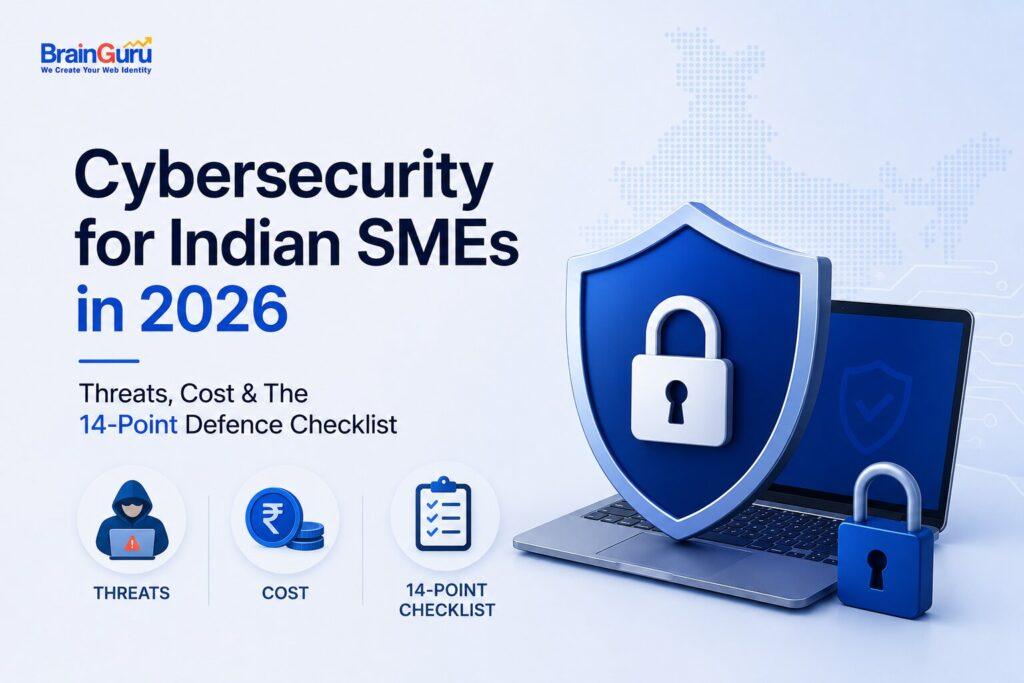
Indian SMEs are getting hacked more in 2026 than ever before, and most don’t know it until the consequences hit. CERT-In data shows reported cyber incidents involving SMEs are up 145% from 2023. Real numbers are likely higher because most SMEs don’t report. The average cost of a single breach for an Indian SME — including downtime, recovery, customer trust loss, and regulatory penalty exposure under DPDP — now exceeds ₹35 lakh. Yet most SME founders treat cybersecurity as an IT problem rather than a business risk problem.
This is the practical 2026 guide to cybersecurity for Indian SMEs. The seven attack patterns Indian SMEs actually face (with real anonymised cases), real ₹ costs of breaches, DPDP-aligned defence, the 14-point checklist you can apply this week, and the “minimum viable security” budget that gets 80% protection at 20% of enterprise cost.
The 2026 Threat Landscape for Indian SMEs
CERT-In’s 2025 report shows three trends:
SMEs are explicitly targeted. Attackers know enterprise has defences; SMEs don’t. The economics for criminals favour Indian SMEs (lower defences, sufficient assets, often regulatory exposure).
Ransomware migrated downmarket. What was once an enterprise problem is now standard for Indian SMEs in healthcare, education, retail, and manufacturing.
Cross-border attacks rose. Attackers from Eastern Europe, Southeast Asia, and Africa increasingly target Indian SMEs, exploiting weaker compliance and reactive postures.
The 7 Attack Patterns Indian SMEs Face
1. Business Email Compromise (BEC) — Most Common
Attacker impersonates senior executive (CEO, founder) and asks finance team to transfer money to a “new vendor” or “urgent supplier”. Often delivered through compromised employee email or domain spoofing.
Typical loss: ₹2L–₹50L per successful incident. The single highest-frequency Indian SME attack.
Real anonymised case: a Pune-based manufacturing SME lost ₹18L when their CFO acted on an “urgent transfer” email that appeared to come from the founder (who was actually travelling). The email was spoofed; the attacker had compromised the founder’s personal Gmail and learned travel patterns.
2. Ransomware on Legacy File Servers
Attackers encrypt critical business files and demand payment for decryption. Indian SMEs running legacy Windows servers or unsupported OS versions are particularly vulnerable.
Typical loss: ₹3L–₹40L (ransom + downtime + recovery). Recovery time: 2–8 weeks even with backups.
3. Credential Stuffing (Reused Passwords)
Employees reuse passwords across personal and work accounts. When a personal account leaks, attackers try the same password on the company’s SaaS tools, email, and admin panels.
Typical loss: depends on what’s compromised. Often hidden — attackers maintain access for months collecting data.
4. Supply-Chain Compromise (Via Vendors)
Attackers compromise your CA firm, payroll processor, or HR consultant — then pivot into your systems through their legitimate access. Indian SMEs have many vendors with weak security.
Typical loss: hard to quantify; often discovered months later through unusual transactions or data leaks.
5. Insider Threat (Ex-Employees + Cloud Accounts)
Departed employees retain access to Google Drive, Slack, AWS console, customer databases for months because nobody revoked their access. Sometimes they take data; sometimes attackers compromise their old accounts.
Typical loss: depends on access. The single most preventable pattern.
6. SaaS Account Takeover (Google Workspace, M365)
Without 2FA, a single phished password gives attackers full Google Workspace or Microsoft 365 access — email, drive, calendar, sometimes other connected SaaS.
Typical loss: enormous. The “single point of failure” attack.
7. WordPress / Website Breaches
The elephant in the room. Most Indian SMEs run WordPress sites with outdated plugins, weak admin passwords, and no security plugin. Breaches lead to: defacement, SEO poisoning (your site rankings get hijacked), customer-data exfiltration, and brand damage.
Typical loss: ₹1L–₹15L direct cost + harder-to-measure SEO recovery.
The Real Cost of a Breach for an Indian SME
| Company Size | Avg Direct Cost (₹) | + Indirect (downtime, trust) | + DPDP Penalty Exposure | Total Risk |
|---|---|---|---|---|
| 10–50 employees | 5–15L | 3–10L | up to 50L | ~10–75L |
| 50–200 employees | 15–60L | 10–30L | up to 1Cr | ~25L–2Cr |
| 200–500 employees | 50L–1.5Cr | 30L–1Cr | up to 5Cr | ~80L–7Cr |
The math: spend ₹15K–₹50K/month on prevention; avoid ₹35L+ exposure. The ROI on basic cybersecurity for Indian SMEs is among the highest available.
DPDP Act Obligations
Under DPDP 2023, businesses processing personal data have specific cyber obligations:
- 72-hour breach notification to Data Protection Board and affected individuals
- Reasonable security safeguards (interpreted as industry-standard practices)
- Data Protection Officer required for Significant Data Fiduciaries
- Breach reporting documentation maintained
For deeper DPDP context, see our DPDP compliance piece.
The 14-Point SME Cybersecurity Defence Checklist
Run through these now. Each “no” is a meaningful risk:
- Multi-factor authentication (2FA) enabled on Google Workspace / M365 for every user — yes/no
- 2FA enabled on all critical SaaS (CRM, banking, AWS console, social platforms) — yes/no
- Password manager deployed company-wide (Bitwarden / 1Password / Zoho Vault) — yes/no
- Email phishing detection enabled (Google Workspace and M365 both have it) — yes/no
- Endpoint protection on every laptop (Microsoft Defender / CrowdStrike) — yes/no
- Automated backups (3-2-1 rule: 3 copies, 2 different media, 1 off-site) — yes/no
- WordPress (if used) on latest version, plugins updated, security plugin (Wordfence) active — yes/no
- Onboarding/offboarding checklists with revoke-access workflows — yes/no
- Vendor access reviews quarterly — yes/no
- Incident response plan documented (who calls whom, what’s first 6 hours) — yes/no
- Cyber insurance evaluated/purchased — yes/no
- Security awareness training completed by all employees annually — yes/no
- 72-hour breach notification process tested — yes/no
- External security audit (or self-audit using this list) every 6 months — yes/no
If you have more than 4 “no” responses, you’re at substantial risk.
Tool Stack — Indian SME-Friendly Options
| Category | Recommended Tools | Cost (₹/mo) |
|---|---|---|
| Password manager | Bitwarden Business (₹150/user) or Zoho Vault | 1,500–6,000 |
| Endpoint protection | Microsoft Defender (free with M365) or CrowdStrike | 0–2,500/user |
| Email security | Built into M365/Workspace or Mimecast | 0–1,500/user |
| Backup | Backblaze, AWS Backup, or in-house | 5,000–25,000 |
| WordPress security | Wordfence Premium or MalCare | 1,500–5,000 |
| VPN (for remote work) | NordLayer or Tailscale | 500–2,000/user |
Total for a 25-person SME: ₹35K–₹75K/month for solid baseline security.
The “Minimum Viable Security” Budget
₹15K–₹25K/month gets a 25-person SME ~80% of the protection of an enterprise stack. The priorities at this budget:
- 2FA everywhere (free)
- Password manager (₹1,500–₹3,000)
- Microsoft 365 or Google Workspace with built-in security (₹5K–₹10K)
- Automated backups (₹3K–₹8K)
- WordPress security plugin (₹1,500–₹3,000)
- Basic endpoint protection (₹3K–₹6K)
This budget doesn’t include incident response or advanced threat detection — those come at the ₹50K+/month tier.
WordPress-Specific Hardening
Since most Indian SMEs have WordPress sites, specific hardening matters:
- Latest WP core + theme + plugin versions
- Strong admin passwords + 2FA on WP admin
- Limit login attempts (Wordfence handles this)
- Disable file editing in wp-config
- HTTPS everywhere (Let’s Encrypt is free)
- Daily backups stored off-server
- Web Application Firewall (Cloudflare free tier or Wordfence)
- Regular security plugin scans
- Update
/wp-admin/to disallowed by IP if possible
Incident Response Plan — The First 6 Hours
When something happens:
- Identify and isolate: what’s compromised, what’s not? Disconnect affected systems from network
- Notify internal stakeholders: founder, IT lead, legal counsel
- Document evidence: logs, timeline, ransom notes if applicable
- Engage external help: cybersecurity incident responder, lawyer
- Contact insurance carrier (if you have cyber insurance)
- Assess data exposure: was personal data involved? DPDP notification timeline kicks in
- Prepare 72-hour breach notification if DPDP applies
Practice this plan annually. Surprise-test if possible.
Cyber Insurance in India
Indian cyber insurance is maturing. Premiums for a 50-person SME: ₹40K–₹2L annually depending on coverage. Coverage typically includes: breach response costs, ransom payment, downtime loss, regulatory penalty reimbursement (where insurable), and reputational restoration.
Worth buying for: any business above ₹5Cr revenue or with significant data exposure. Below that, the cost may exceed expected benefit.
Free Brainguru Password Tool
Start with the basics. Use our free password strength checker to audit your team’s passwords. The simplest first-step diagnostic for SMEs is “do our people use weak passwords?”. The answer is almost always yes.
Frequently Asked Questions
What’s the cheapest first step in cybersecurity for an Indian SME?
2FA on Google Workspace or M365. Free, takes 30 minutes, eliminates most account-takeover risk.
Should small Indian SMEs hire a CISO?
Below 100 employees: virtual CISO (vCISO) services at ₹50K–₹2L/month make more sense than full-time hire. Above 100 with significant data exposure: yes, full-time CISO.
What’s the most overlooked SME security risk?
Insider threat from offboarded employees. Most SMEs don’t have rigorous access-revocation workflows. Ex-employees retain access for months.
Do Indian SMEs need to worry about ransomware?
Yes. The “ransomware only hits big companies” myth is dangerously wrong in 2026. Indian SMEs in healthcare, education, retail, and manufacturing are actively targeted.
What’s the right time to start cybersecurity for a startup?
Day 1. The baseline (2FA, password manager, backups, M365 or Workspace) costs almost nothing and prevents most attacks. Don’t wait until you have something worth stealing.
How often should we run security audits?
Self-audit using the 14-point checklist quarterly. External audit annually. After any incident or major change (new SaaS, new office, etc.), reassess.
The Bottom Line
Cybersecurity for Indian SMEs in 2026 isn’t a “nice to have” — it’s basic business risk management. The cost of prevention (₹15K–₹50K/month at most tiers) is dramatically lower than the cost of incident (₹10L–₹2Cr). Yet most SMEs underinvest, treating cybersecurity as an IT problem rather than a business problem.
The 14-point checklist in this guide is the start. Run it this week. Close the worst gaps. Get to “minimum viable security” within a quarter. After that, scale up based on your specific risk profile.
For a focused 90-minute audit and prioritized remediation roadmap, our cybersecurity team works with Indian SMEs on this exact problem. For application-level security reviews, see our application security services. For accessibility testing (related), see accessibility testing. Audit team passwords with our free password strength checker. Or reach out via our contact page.
Related on this blog: DPDP Act 2023 Compliance for Digital Marketers (regulatory overlap), the upcoming AWS vs Azure vs GCP comparison for cloud security, and the GA4 Setup for Indian eCommerce piece for consent-mode integration.
Ready to Grow Your Business?
Get a free consultation from Brainguru Technologies — 13+ years of helping Indian businesses succeed online.
Get Free ConsultationOr call us: +91-8010010000 | Email: info@brainguru.in