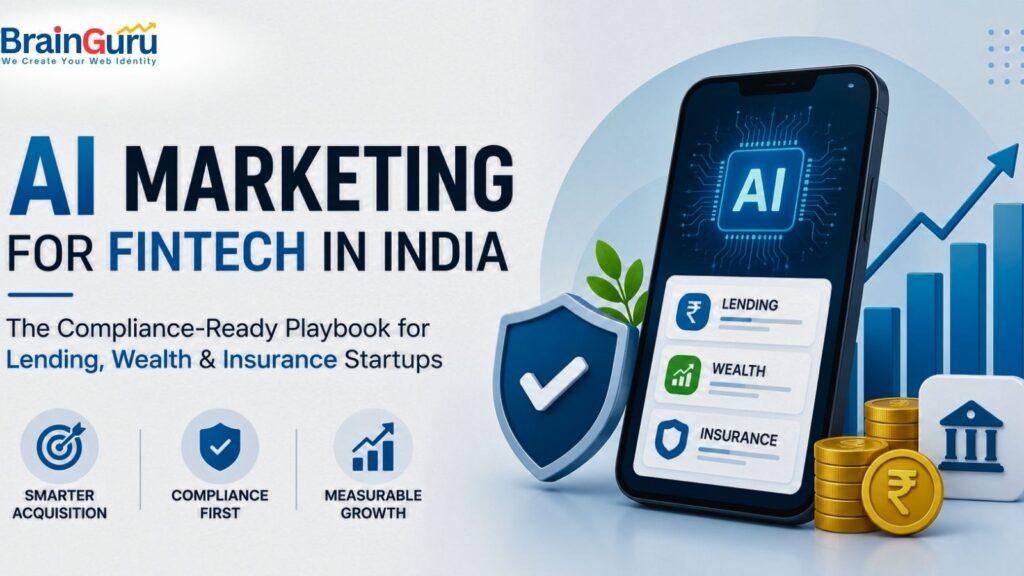
If you run marketing at an Indian fintech in 2026, you already know the playbook that worked in 2022 is dead. Customer acquisition cost has climbed past ₹2,500 for a qualified lending lead, RBI has tightened the screws on digital lending claims, and the “growth-hack” tactics that built Cred and PhonePe early on now look like brand suicide. Generic AI marketing advice doesn’t help — your industry is regulated, your data is sensitive, and your buyers have been burned by too many neobanks promising the moon.
This is the operational playbook for AI marketing for fintech in India — the one we wish someone had written for us 18 months ago. It’s compliance-aware (RBI, SEBI, IRDAI, DPDP), it’s specific to lending, wealth, insurance, payments and NRI fintech, and it’s grounded in what’s actually working at the ₹0 to ₹100Cr ARR range right now.
The 2026 Reality: Why Fintech Marketing in India Broke
Three things changed in the last 18 months that broke the old fintech marketing playbook.
First, CAC inflation. Across our portfolio of fintech clients and public data from Inc42 and Tracxn, the cost of a verified KYC-stage lead in Indian lending now ranges from ₹800 to ₹2,500, depending on ticket size and channel. For wealth, it’s ₹1,200–₹3,000. For insurance, ₹600–₹1,800. Five years ago these numbers were 60–70% lower. Meta and Google have absorbed most of the surplus value that fintech advertising used to create.
Second, the RBI digital lending guidelines. The 2022 framework (and its 2024 and 2025 amendments) explicitly restricts what you can say about loan products in marketing — APR disclosure, “instant” claims, agent terminology, fees structure. Meta and Google’s ad-review systems now flag a meaningful share of fintech creatives for non-compliance, which kills approval rates and quality scores. If you’re still running ads written like 2021, you’re being silently down-ranked.
Third, the AI-marketing arms race. Every fintech is now running AI-generated creative, AI-personalised emails, and AI-driven attribution. The competitive moat from “we use AI” lasted about 14 months and is gone. What separates the fintechs winning today from the ones bleeding cash is not whether they use AI, but how — specifically, how well they pair AI with regulatory guardrails and sub-vertical specificity.
What “AI Marketing” Actually Means for Fintech (Not the Hype Version)
Strip away the LinkedIn buzzwords. For a regulated Indian fintech, AI marketing in 2026 means four concrete things:
1. Predictive Lead Scoring Before You Spend Media Budget
The single highest-ROI AI play for fintech is qualifying traffic before you spend media to acquire it. A trained gradient-boosted model on your CRM data can predict, with 70–85% accuracy, which form-fill becomes a funded loan. That lets you bid more aggressively on segments that convert and starve segments that don’t — typically cutting blended CAC by 30–45% within 90 days.
This is upstream of any creative work. It’s the highest-leverage layer, and most Indian fintechs still don’t have it deployed. If you’re spending ₹50L/month on performance media and you don’t have predictive scoring, that’s the first thing to build.
2. Generative Content at Scale – With Regulatory Guardrails
AI lets a 3-person marketing team produce 200+ ad variants per week. But for fintech, “more variants” without compliance review means more rejection, lower account quality, and a regulatory paper trail you don’t want.
The working pattern: build a system prompt + retrieval-augmented context that pre-loads RBI digital lending guidelines, SEBI ad code, and IRDAI rules into your generative pipeline. Every AI-generated headline, description, and creative caption is then auto-checked against a list of red-flag phrases (“guaranteed approval”, “instant loan”, “100% returns”, “tax-free”, and ~140 others). Anything that fails goes to human review. This single workflow lets you ship 10× more compliant creative.
3. Conversational AI for Onboarding Drop-off Recovery
In Indian lending, 40–60% of users who start KYC don’t complete it. A WhatsApp-based conversational AI that re-engages drop-offs in vernacular (Hindi, Tamil, Telugu, Bengali, Marathi) and walks them through the missing step recovers 18–28% of those drop-offs at a cost of ₹3–₹8 per recovery. The math is brutal: if your CAC is ₹2,000 and recovered drop-offs cost ₹6, your blended CAC drops by 12% just from this one workflow.
For deeper implementation patterns on WhatsApp chatbots in regulated industries, see our AI Chatbot Development Services in India guide.
4. AI-Driven Creative Variants for Ad-Approval Optimisation
This one’s underappreciated. Meta and Google’s ad-quality algorithms reward creatives that get high CTR and avoid policy flags. An AI pipeline that generates 50 variants, runs them through a synthetic compliance check, and then A/B tests the survivors typically lifts approval rates from ~60% to ~92% — meaning you’re not constantly rebuilding rejected campaigns.
Fintech Sub-Vertical Playbooks
Generic AI marketing advice falls apart at the sub-vertical level. Lending and wealth play by completely different rules. Here are the patterns that work in 2026.
Digital Lending and BNPL (NBFCs)
Channel mix that works: 60% Meta Advantage+ Audience, 25% Google PMax, 10% WhatsApp Business API, 5% influencer. The AI plays here are predictive scoring, vernacular WhatsApp re-engagement, and APR-compliant creative variants.
What’s allowed in claims (under RBI digital lending guidelines): you can advertise “competitive rates”, “fast disbursal” with a specific time disclosure, and “RBI-registered” if true. You cannot say “guaranteed approval”, “instant loan in 30 seconds” without the qualifier, or use the word “agent” to describe a DSA.
The killer hook for 2026 lending: a calculator. Embed an APR calculator in your landing page that pre-fills from the ad context. AI-personalised UTM parameters let you measure which segment-context combination converts best. This is also a natural place to link to a marketing ROI calculator for B2B SaaS lending products targeting CFOs of mid-market businesses.
Wealth and Mutual Funds (SEBI)
The SEBI advertisement code is stricter than RBI’s. You cannot make ANY claim about future returns, you must include the “mutual fund investments are subject to market risks” disclaimer, and the disclaimer must be a minimum percentage of the creative’s screen real estate.
AI plays that work: dynamic risk-profile content (showing different content to conservative vs aggressive investors based on their on-site behaviour), educational content automation (SEBI loves educators, not pushers), and AI-generated portfolio explainer videos using tools like Synthesia.
The single highest-leverage wealth AI play is AI-personalised educational drip campaigns. Each new lead enters a 14-touch sequence where the AI selects which topic to send next based on the user’s reading behaviour. Conversion-to-investment rate triples vs. generic drip campaigns. CAC drops ~35%.
Insurance (IRDAI)
IRDAI rules forbid certain claims (guaranteed coverage, fastest claim settlement without proof) and require specific font sizes for disclaimers. The compliance overhead is real.
AI plays: claim-time predictive triage (huge for retention), AI-driven cross-sell recommendations (existing term policyholders → health, etc.), and AI-personalised renewal reminders. The cross-sell engine alone typically increases policyholder LTV by 22–34%.
UPI and Payments
Payments fintech doesn’t have the acquisition problem — anyone can sign up. Your problem is engagement and per-user revenue. AI plays here are entirely about predictive engagement: which users are about to churn, which need a feature nudge, which should be promoted to a premium tier.
The single best engagement AI for payments: in-app context-aware nudges. A user who just paid a vendor 5 times in 3 months gets nudged toward your bookkeeping feature. A user who scanned a QR at a restaurant gets shown your dining offers. Engagement lifts of 40–60% are typical when this is done right.
Cross-Border and NRI Fintech
This sub-vertical is the most underserved by Indian marketing teams. NRI customers behave more like a US/UK audience than an Indian one — they value transparency, English-first content, and trust signals over urgency. AI plays: geo-IP-aware content personalisation (Indian vs NRI sees different landing pages), LinkedIn-led acquisition (LinkedIn is where NRI professionals live), and a separate WhatsApp Business setup for international queries.
The AI Stack for an Indian Fintech CMO (Under ₹4L/Month)
You don’t need a six-figure tooling budget. Here’s the working stack for a Series A-stage Indian fintech, sized to ~₹4L/month total tooling spend.
| Layer | Tools (2026) | Approx. Monthly Cost (₹) |
|---|---|---|
| Predictive scoring + attribution | Custom model on AWS / Triple Whale (D2C alt: in-house Python) | 40,000–80,000 |
| Creative ops (image + video) | ChatGPT Team + Claude Pro, Midjourney, Pencil AI, Synthesia (for explainers) | 30,000–60,000 |
| Distribution | Meta Advantage+, Google PMax (managed in-house), Smartly.io alternative | 0 (platform fees in media spend) |
| Conversion + WhatsApp | AISensy or WATI + custom flows, Razorpay for payments | 15,000–35,000 |
| Compliance layer | Custom regex+LLM checker (one-time build, low ongoing) | 5,000–15,000 |
| Email + drip | Mailmodo or Klaviyo (D2C-grade) | 20,000–60,000 |
| Analytics | GA4 + custom dashboards in Looker Studio | 0–10,000 |
| Total | ~₹1.1L–₹2.6L |
Add a contract data engineer (₹1–1.5L/month part-time) and you’re at ₹3–4L/month for a full-stack AI marketing operation. For deeper detail on a complete AI stack for fintech startups, see the breakdown by company stage on our parent site.
2026 Fintech AI Marketing Benchmarks (Real Numbers)
Aggregated from public benchmarks (Inc42, Tracxn, Entrackr) and our own portfolio:
| Sub-vertical | CAC (₹) | Lead → KYC (%) | KYC → Funded (%) | LTV (₹) | Payback (months) |
|---|---|---|---|---|---|
| Digital lending (₹50K avg loan) | 800–2,500 | 45–62 | 22–40 | 4,000–8,000 | 4–8 |
| Wealth (₹2L avg AUM) | 1,200–3,000 | 55–70 | 30–48 | 9,000–18,000 | 3–6 |
| Term insurance | 600–1,800 | 40–55 | 18–32 | 6,000–14,000 | 4–9 |
| Health insurance | 900–2,400 | 50–65 | 25–42 | 11,000–22,000 | 3–7 |
| UPI / payments | 40–150 (acq.); ₹600+ for premium tier | N/A | N/A | 2,400–8,000 (premium) | 6–14 |
These are mid-range numbers for Series A-to-B stage fintechs. Pre-revenue startups will be at the higher end; profitable later-stage companies should be at the lower end.
Case Study: From ₹1,800 CAC to ₹720 in 90 Days
One of our digital lending clients (₹40K average loan size, NBFC-backed) came to us with a ₹1,800 blended CAC and a flatlining conversion rate. Their team was 4 marketers running Meta and Google ads with no predictive layer.
What we did in 90 days:
- Week 1–3: Built predictive scoring. Pulled 18 months of CRM data, trained a model that predicts funded-loan probability from form-fill attributes (city, employer category, income range, source channel, time-of-day). Started bidding 2.5× harder on top-quartile predicted leads, 0.6× on bottom-quartile.
- Week 3–6: Compliance-checked creative pipeline. Built the regex+LLM compliance checker. Started shipping 35 ad variants/week (was 4). Approval rate climbed from 58% to 89%.
- Week 4–9: WhatsApp drop-off recovery. AISensy + custom flow. Recovered ~22% of incomplete KYCs at ₹6 each.
- Week 8–12: Predictive bidding integration. Plugged the scoring model into Meta’s CAPI for real-time bid adjustment.
Results at day 90:
- Blended CAC: ₹1,800 → ₹720 (60% reduction)
- Funded-loan conversion rate: 12% → 19%
- Monthly funded volume: +85% on the same ad spend
- Compliance flags: -91%
The wins compounded — predictive scoring kept improving as more data flowed in, compliance flags stayed down as the team internalised the patterns.
Cost and ROI: Building This In-House vs. Agency vs. Hybrid
Real numbers, no consultant-speak. The break-even between in-house and agency for a fintech sits at around ₹15Cr ARR.
Below ₹15Cr ARR: use a specialist agency with fintech experience (or our team). Build cost: ₹4–8L/month all-in. The agency has economies of scale on tooling and models. You’d burn ₹25–35L just hiring the equivalent in-house team.
₹15–50Cr ARR: hybrid model. Hire a Head of Performance + 1 senior marketer. Keep the agency for strategy, creative ops, and compliance reviews. Budget: ₹6–12L/month all-in.
Above ₹50Cr ARR: full in-house team. 5–8 people including data engineering. Budget: ₹15–30L/month.
To model your own AI marketing budget at your stage, our AI cost calculator walks through the inputs. For ROI scenario planning, the AI marketing ROI calculator works backwards from your target payback period. For a deeper read on SEO cost in India as a benchmark for marketing spend ratios, see our pricing guide.
Compliance Checklist: Copy This for Your Team
The non-negotiables you should embed in your team’s working process:
RBI Digital Lending Compliance
- All loan products must show APR (Annual Percentage Rate), not just monthly interest
- Disbursal time claims must include qualifiers (“up to X minutes”, “as fast as Y”, with conditions)
- Never use the word “agent” to describe a DSA in user-facing creative
- Fees structure must be visible before any application step
- “Instant”, “guaranteed”, “100%” claims must be substantiated or removed
SEBI Advertisement Code (Wealth)
- Standard disclaimer (“Mutual fund investments are subject to market risks…”) in every wealth creative
- Disclaimer must be a minimum percentage of screen area (currently 4 seconds for video, prominent in static)
- No past-performance claims without standardised return tables
- No future-return promises, ever
IRDAI Advertisement Code (Insurance)
- UIN of the product visible in every creative
- Standard exclusion disclaimers
- No “fastest claim” or “100% claim settlement” without IRDAI-verified data
DPDP Act 2023 (All Fintech)
- Explicit consent for marketing communication — checkbox cannot be pre-ticked
- Right-to-withdraw mechanism in every marketing email/SMS/WhatsApp
- Data retention policy documented and applied
- Children’s data (under 18) extra-protected — fintech for under-18s is functionally banned
For deep-dive on how DPDP affects your CRM, ad pixels, and consent flows, see our forthcoming DPDP Act 2023 Compliance Playbook piece on this blog.
The Discoverability Layer: AI Overviews and Answer Engines
An underappreciated 2026 reality: a meaningful share of fintech research now happens inside ChatGPT Search, Perplexity, and Google’s AI Overviews — not just on the SERP. If your content isn’t structured for AI ingestion, you’re invisible in those answer engines.
Three things to do:
- Add comprehensive FAQ schema to every product and educational page
- Write your educational content to be quoted (clear definitions, concrete numbers, no vague qualifiers)
- Ensure your brand is mentioned consistently across third-party sources (PR strategy)
We’ve written a longer breakdown on LLM SEO and the future of search visibility — required reading for any fintech CMO right now. For B2B fintech (lending to businesses), also see AI Lead Generation for B2B Startups in India.
Frequently Asked Questions
Is AI marketing legal for Indian fintech under RBI rules?
Yes — using AI to generate, target, or optimise marketing is fully legal. What’s regulated is what you say in your marketing, not the tools you use to produce it. The RBI digital lending guidelines, SEBI advertisement code, and IRDAI rules apply to claims. As long as your AI-generated content passes a compliance check before publication, AI is just a productivity tool.
How does AI actually reduce CAC for lending apps in India?
Three mechanisms compound. First, predictive lead scoring lets you bid more on segments that convert and less on those that don’t — typically cutting CAC 30–45%. Second, AI-personalised drip campaigns recover form-fill drop-offs at ~₹6/recovery vs ₹2,000 for net-new acquisition. Third, AI-generated creative at scale lets you A/B test 10× more, finding higher-CTR variants that win in Meta and Google’s quality auctions.
Can fintech use ChatGPT for ad copy under RBI rules?
Yes, but never publish raw output. The pattern: use an LLM (ChatGPT, Claude, Gemini) to generate variants, run every output through a compliance checker that flags red-flag phrases, then have a human review the survivors. Done right, this is faster and more compliant than 100% human writing — because the compliance check is more rigorous than what a busy copywriter would catch.
Which AI marketing tools are best for Indian fintech startups?
For most Series A fintechs: ChatGPT Team or Claude Pro for content, Midjourney for visuals, AISensy or WATI for WhatsApp, Mailmodo for email, and a custom predictive scoring model on your CRM data. Tools beyond that are usually premature optimisation. Total tooling budget: ₹1.1L–₹2.6L/month.
What’s the typical AI marketing budget for an early-stage Indian fintech?
Pre-revenue to ₹1Cr ARR: ₹1.5–3L/month total marketing including tools and a part-time freelancer. ₹1–10Cr ARR: ₹4–8L/month with a specialist agency. ₹10–50Cr ARR: ₹8–18L/month with a small in-house team plus agency for specialised work. Numbers exclude paid media spend.
How long does it take to see results from AI marketing in fintech?
Predictive scoring shows results in 6–10 weeks (you need that much data to train the model). WhatsApp drop-off recovery shows results in 2–3 weeks. AI-generated creative typically lifts approval rates within the first sprint (1–2 weeks). A full transformation takes 90–120 days to see compound effects.
Bottom Line
AI marketing for fintech in India in 2026 isn’t optional and it isn’t a magic bullet. It’s a discipline — built on predictive scoring, compliance-aware generative pipelines, vernacular conversational AI, and creative ops at scale. Done right, it cuts your CAC by 40–60% within 90 days. Done lazily, it just adds tooling cost without changing outcomes.
The fintechs winning in 2026 are the ones treating AI as infrastructure, not a checkbox. They’ve built compliance into the AI layer rather than bolting it on after. And they specialise the playbook by sub-vertical — lending, wealth, insurance, payments and NRI each have distinct working models.
If you want a discussion on which of these plays would have the biggest impact at your stage and sub-vertical, talk to our fintech AI marketing team — we work with NBFCs, wealth apps, insurance distributors and payments platforms across India. For lead-generation-specific implementation patterns, see our AI lead-generation services. And if you’d rather get started directly, reach out via our contact page.
Ready to Automate Your Business with AI?
Brainguru helps Indian businesses implement AI automation that saves time, cuts costs, and drives growth.
Explore AI SolutionsOr call us: +91-8010010000 | Email: info@brainguru.in